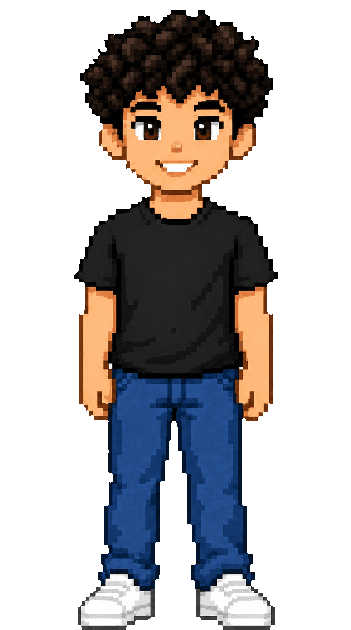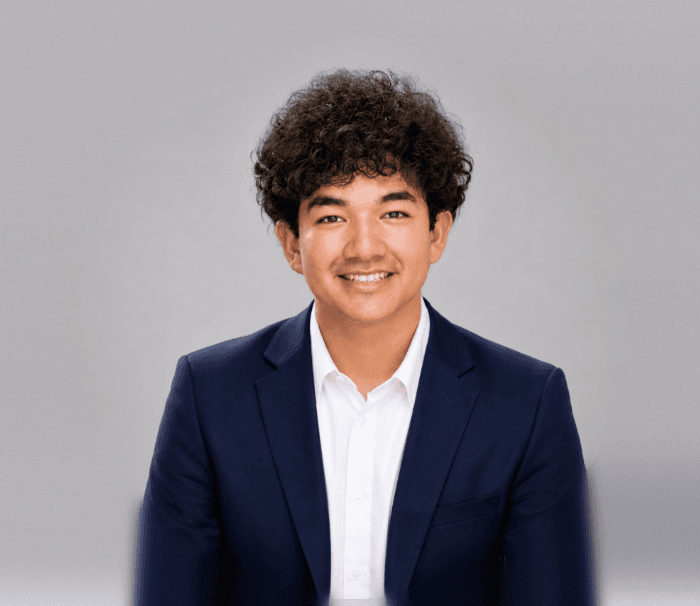
Christian Artigas
A computer engineering student who works from transistors up to cloud services, and finds the same question interesting at every level.
Two halves of the same question
I started by taking things apart to find out why they worked. I have not really stopped — the things just got bigger.
Keep going
I'm a computer engineering student at UCF. The degree puts analog electronics and operating systems in the same semester, and after a while you stop treating them as separate subjects.
Electronics came first — biasing transistors, sketching Bode plots, arguing with LTspice about why the breadboard disagreed with the screen. Then programming, then embedded systems, where the two finally met. There is a bug you only get on a microcontroller, where the code is right and the timing is wrong; learning to find those changed how I debug everything else.
Now most of my week goes into software, as a developer intern at Intrastack Solutions — leading the front-end track on an AI proposal platform and working on the CRM side of a multi-service point-of-sale system. I like building things that work end to end, and knowing what happens one layer below wherever I am. Different vocabulary, same curiosity.
- Studying
- B.S. Computer Engineering, UCF
- Graduating
- May 2027
- Based in
- Orlando, FL
- Currently
- Developer intern at Intrastack Solutions
- University of Florida2022 — 2023
- Santa Fe College2022 — 2023
Things I built, and what each one cost me
They do not look alike because they were not alike — a service topology and a microcontroller are different problems, and the page should say so.
- Entries
- 04
- Treatments
- 04
- Layers spanned
- 5 / 5
Keep going
Dragon POS / CRM
- Role
- Developer intern — CRM and customer-service side
- Context
- Intrastack Solutions
- Period
- 2026 — Present
A cloud-oriented point-of-sale and CRM platform built as a set of cooperating services rather than a single application. I work on the customer side of it.
Highlighted: the service I work on.
A Customer Profile Service where every read and write is tenant-aware. Soft deletion so history survives, and GDPR-oriented deletion that genuinely removes a person — two requirements pulling opposite ways in one data model.
Customer CRUD and lookup endpoints running inside the wider service architecture, built to the platform's REST conventions and reviewed by the team before merge.
What it taught meThat multi-tenancy is not a filter you remember to add — it belongs in the layer underneath the queries, because anywhere it is optional is eventually where it gets forgotten.
- NestJS
- TypeScript
- PostgreSQL
- Prisma
- Redis
- Kafka
- JWT + refresh tokens
- Docker
- GitHub Actions
Described at an architectural level. No proprietary implementation details are shown.
BidOps AI
- Role
- Front-end track lead
- Context
- Intrastack Solutions
- Period
- 2026 — Present
An enterprise platform for managing proposal and document workflows. I lead the front-end track: the application shell, the authentication flows, and the proposal workspace.
middleware → 403
redirect("/unauthorized")
Hiding a link is not access control. Try the roles — the routes change, and so does what the server would allow.
Role-based access control that holds at every layer. A hidden nav link is not access control — the route, the middleware, and the server-side session all have to agree, and I found and closed gaps where they did not.
An application shell with protected routes, server-side session handling, schema-validated forms, and a Vitest suite covering the authentication paths.
What it taught meFront-end engineering is mostly about trust boundaries. The interface is the last place a permission decision should be made, not the first.
- Next.js
- TypeScript
- Tailwind CSS
- shadcn/ui
- TanStack Query
- React Hook Form
- Zod
- Supabase SSR auth
- Vitest
Described at an architectural level. No proprietary implementation details are shown.
MSP430 Sensing Prototype
- Role
- Firmware and hardware
- Context
- Embedded systems coursework and lab work
- Period
- University project
A microcontroller prototype that reads the physical world and reacts to it: ultrasonic distance in, LCD and MOSFET-switched output out, with everything in between running on a 16-bit MCU.
Timing. An ultrasonic echo is measured in microseconds, the LCD wants writing slowly, and the PWM cannot stutter while either happens. Sharing one timer subsystem meant thinking in interrupts, not sequential code.
A working prototype: distance sensed and displayed live, an ADC-read potentiometer driving PWM duty cycle, and a MOSFET switching a load the MCU could not drive directly.
What it taught meOn a microcontroller you can see your own bugs. An oscilloscope shows you the mistake in the signal, which is a very different debugging experience from reading a stack trace.
- MSP430FR6989
- MSP430G2553
- C
- ADC
- PWM
- Timers
- UART
- I2C
- GPIO
- Ultrasonic sensor
- MOSFET switching
TimeTrack
- Role
- Front-end and mobile developer
- Context
- Team project — deployed at markstevens.tech
An application for scheduling, time tracking, task management, and productivity reporting, built by a team. I worked on the front end and the mobile side, building the interfaces people actually schedule and log their time in.
- Scheduled
- 31.0h
- Logged
- 30.5h
- Variance
- -0.50h
Planned time and actual time are not the same thing, and most trackers conflate them. Keeping scheduled blocks and logged entries distinct in the interface — on a phone screen as well as a desktop one — is what makes the difference visible.
Scheduling and logging views across web and mobile, consuming the platform's APIs, deployed and reachable rather than sitting in a repository.
What it taught meWorking on one part of a shared codebase means the contract with everyone else is the thing to get right. The interface can only be as clear as the data it is handed.
- React
- TypeScript
- REST APIs
- Git
The parts I study, running
Neither is a product. They are the two subjects I keep going back to, built here as working instruments — the numbers on screen come out of the maths in the repository.
- Instruments
- 02
- Computation
- client-side
- Source
- lib/signal, lib/ml
Keep going
Electronics
Analog design analysed on paper, verified in LTspice, then built. Filters are where a transfer function stops being algebra and starts being a component you have to choose.
- Transistor amplifiers
- Common-emitter
- Common-source
- Common-drain
- Small-signal analysis
- Biasing
- AC analysis
- Frequency response
- Bode plots
- Filters
- RLC circuits
- Diodes & Zeners
- Clipping / clamping
- LTspice
- Vivado
- MATLAB
- R
- 318 Ω
- C
- 100 nF
- Q
- 0.71
- |H| at fc
- -3.0 dB
Component values solved from fc = 1 / (2πRC) for a 100 nF capacitor — the curve is evaluated from the transfer function, not traced. A decade past the cutoff the response is -20.0 dB.
Machine learning
The mathematics first: gradient descent, decision boundaries, and the evaluation discipline that decides whether a model is worth anything. Accuracy alone is a number that hides things.
- Logistic regression
- Softmax regression
- KNN
- Naive Bayes
- SVM
- Decision trees
- Ensemble learning
- Gradient descent
- Polynomial regression
- Regularization
- K-Means
- Confusion matrices
- Precision / Recall / F1
- ROC / AUC
- Cross-validation
class 1 class 0 misclassified
- Accuracy
- 0.500
- Precision
- 0.500
- Recall
- 0.844
- F1
- 0.628
- Loss
- 0.7699
Logistic regression, batch gradient descent on cross-entropy loss, learning rate 1.4. The classes overlap on purpose — a dataset that separates perfectly makes precision and recall meaningless.
Grouped by where they sit in the stack
Not by how good I claim to be at them. A percentage next to a language name has never told anyone anything true.
- Groups
- 07
- Entries
- 83
- Rating bars
- 0
Keep going
Languages
L2 · SoftwareWritten across coursework, personal projects, and professional work.
- C
- C++
- Java
- TypeScript
- JavaScript
- Python
- SQL
- Verilog
- MIPS Assembly
Where the work happened
- Roles
- 02
- Institutions
- 03
- Certifications
- 04
Keep going
Developer Intern
Intrastack Solutions·Orlando, FL
Enterprise software and AI-driven web applications alongside the engineering team, across both the retail management and proposal management platforms.
- Lead the front-end track on BidOps AI: application shell, auth flows, and the proposal workspace.
- Work the CRM side of the Dragon POS platform, including a tenant-aware customer profile service.
- Identified and helped close authentication and access-control gaps, not only shipped features.
- Organise work in an Agile team, with debugging, testing, and code review as routine.
- TypeScript
- React
- Next.js
- NestJS
- PostgreSQL
- REST APIs
- Supabase Auth
- RBAC
Cafe Operations Worker
Haan Coffee·Orlando, FL
Front-of-house and operations in a high-volume cafe — worked alongside a full course load and the internship.
- Handle orders, preparation, stocking, and equipment during peak service.
- The kind of job that teaches you to keep a queue moving and to stay precise when it is busy.
- University of Central Florida2023 — 2027
B.S. Computer Engineering
- University of Florida2022 — 2023
Computer Engineering
- Santa Fe College2022 — 2023
Computer Engineering
- Database Foundations
- Relational Databases Essential Training
- Python Programming with Data Analysis
- Excel Boot Camp
Let's buildsomething.
I'm looking for software, embedded, or systems internships for 2026 and beyond. If you have something that spans more than one layer of the stack, that is the kind of problem I want.